


I’ve been inconsistent with this newsletter for a while, and I haven’t known how to explain myself — so let me just say it.
Eight months ago, I had a baby, my second. I kept it private, in part because of the sideways looks I’ve gotten before for choosing to have children while spending years researching and talking about how hard climate change presses down on our reproductive decisions. It’s all connected to the fascinating (and at times, crushing) interactions at play between matrescence and eco-distress (check out my colleague Allison Davis’ work if you want to learn more about those juicy terms). But here’s the truth: it’s precisely because I’ve thought so much about how the reproductive decisions, reproductive justice, and what my colleague Jade Sasser calls “reproductive refusal” of younger generations is being reshaped in a heating world that I got into this work in the first place. And now, with a newborn and everything that first year demands, bandwidth has been pressed.
On top of that, I’m back at Stanford full time, leading CIRCLE, our research and action program on climate and mental health, and it takes a lot of cognitive resource. Underneath that, my father, who I’ve always been fiercely close with, has Alzheimer’s, and his decline has accelerated recently in a way that haunts me daily and drains whatever’s left. Add in a major move last year that upended our family’s entire practical life, and you get the shape of it: survival mode, each day feeling about two seconds long, the classic sandwich-generation scramble. If you’ve lived any version of this yourself, you know exactly what I mean. It’s all amounted to a period of being creatively zapped and feeling as though I have very little to say, which is out of character for me as a science communicator and someone whose internal, analytical world is typically very active.
But I’m coming back to myself now. And I’ve spent a lot of time thinking about what I’m actually willing and able to give this newsletter going forward. The answer is: a dedicated weekly rhythm and a shift in what this space is for. From here onwards, Unthinkable on Substack (as opposed to Unthinkable my nonprofit) is no longer a parallel project running alongside my research at Stanford; it’s where I process and share what that research is actually teaching me, in real time. Just without the academic jargon.
Each edition of this newsletter will now move through three parts: The Weight — naming the problem honestly. The Work — what actually needs to happen about it. The We - what we can do, together and in our own lives, starting now. I’ll also add a section, on weeks where it fits, called The Weave: a place to plug relevant outputs of mine that connect with the field and space I’m covering (events, podcasts, new toolkits, papers, etc).
This newsletter, in keeping with the spirit of my last book Generation Dread, has always made room to sit with the hard emotional and psychological weight of ecological breakdown and climate heating, and I stand fully behind that work. Dedicated spaces built to validate and hold it with others are rare and necessary. That doesn’t change. But going forward, I’m going to give at least equal or more weight to what stokes agency: information that inspires action and new ways of thinking about the part each of us has to play in building something better together, without abandoning the tough stuff needs to be named so it can be healed.
In short, I am widening my lens on what actually protects our communities and what the science shows builds self- and collective efficacy, because without change on the outside, what’s happening on the inside will only keep getting harder. And even though we’re headed for increasing hardship, there’s always more magic to unearth about how we strengthen ourselves and stretch wide enough to meet whatever new shade of the climate, nature and related social crises we’re in, arriving in each moment with our humanity, good will and dedication to act in the service of life.
Thanks for being a part of the conversation, whether you’re a long time reader or new subscriber. We’re all on this crazy carpet ride into planetary discontinuity together. Let’s make it as supportive, inspiring of action, and thoroughly engaged as possible.
With love,
Britt
The Weave
I’m delighted to share a podcast interview with you on “Transformational Resilience in the Climate Crisis” In this episode, I was interviewed by collective trauma expert Thomas Hübl on his podcast - Point of Relation. Here are some of the themes we explored together:
A new model of resilience that focuses on growth and continuous collective adaptation to changing conditions
Examining the subtle ways we engage in “soft denial” by closing one eye to the full truth of the climate crisis and its emotional impact.
How intergenerational connections and conversations can fuel youth activism and combat climate distress and despair
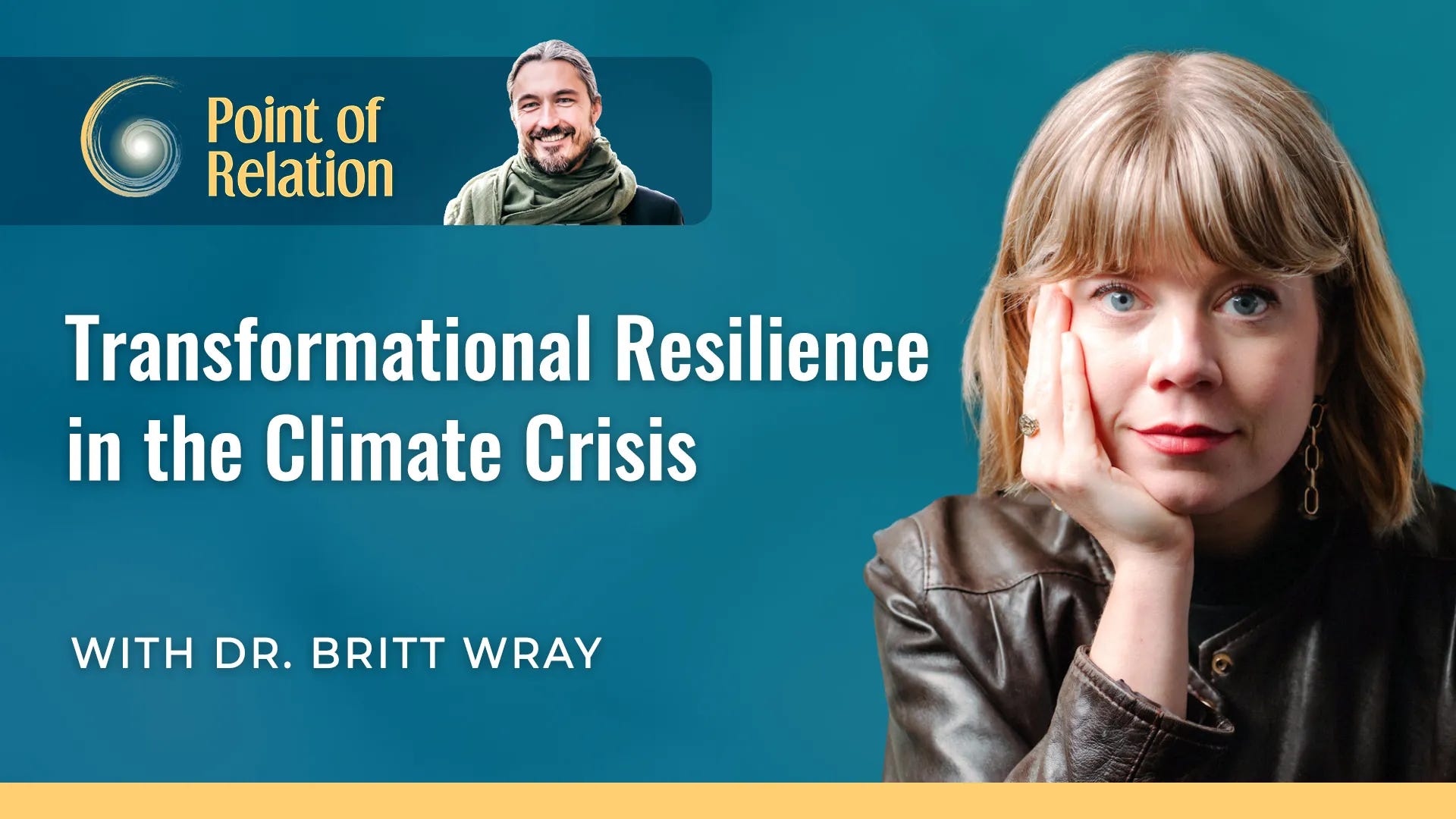
Check out Point of Relation to learn more about how trauma-healing and inner work are essential for anyone working towards systems change. Available on all podcast platforms and Youtube.
~~~~~~~~~~
If you’re a science communicator or journalist interested in learning about how to cover the topic of maternal eco-distress in ways that reflect what the science shows, check out our Maternal Ecodistress Toolkit, which I collaborated on with matrescence and mental health expert Dr Allison Davis. Thanks to the Schmidt Sciences Catalyst Grant for making this offering to professional communicators possible.
~~~~~~~~~~
Lastly for this week, my brilliant colleague Steffi Bednarak and her Centre for Climate Psychology are offering a 10 week course that teaches “a framework to increase agency and systems literacy in complex times” and a Masterclass on Systems Wayfinding that I suspect will be of interest to a lot of you.
Just wanna thank you for sharing your recent struggles and for keeping writing this newsletter, in spite of everything you're going through.
Your words and your work are always inspiring to me. Good luck for the coming months.
Kind regards from France.
Dear Britt,
I am so glad that you made the courageous and wise decision to have a child. I fully understand your worries, but there are so many ways we can solve the climate crisis and also be parents - one of life's most beautiful experiences. We can - as a society - focus on reducing our consumption, so that there is space on this planet for us all, and our children. Since 1950, our energy consumption per person has doubled. And that's a global average, so in richer countries, read "more than doubled". In those same countries, we lived well in the 1950s. So, let's focus our efforts on pushing our societies to consume less, so that lovely young people can have families and feel good about doing so.
Best wishes,
Alasdair