

Beyond Ecological Grief
climate communications should not only make us feel comfortable

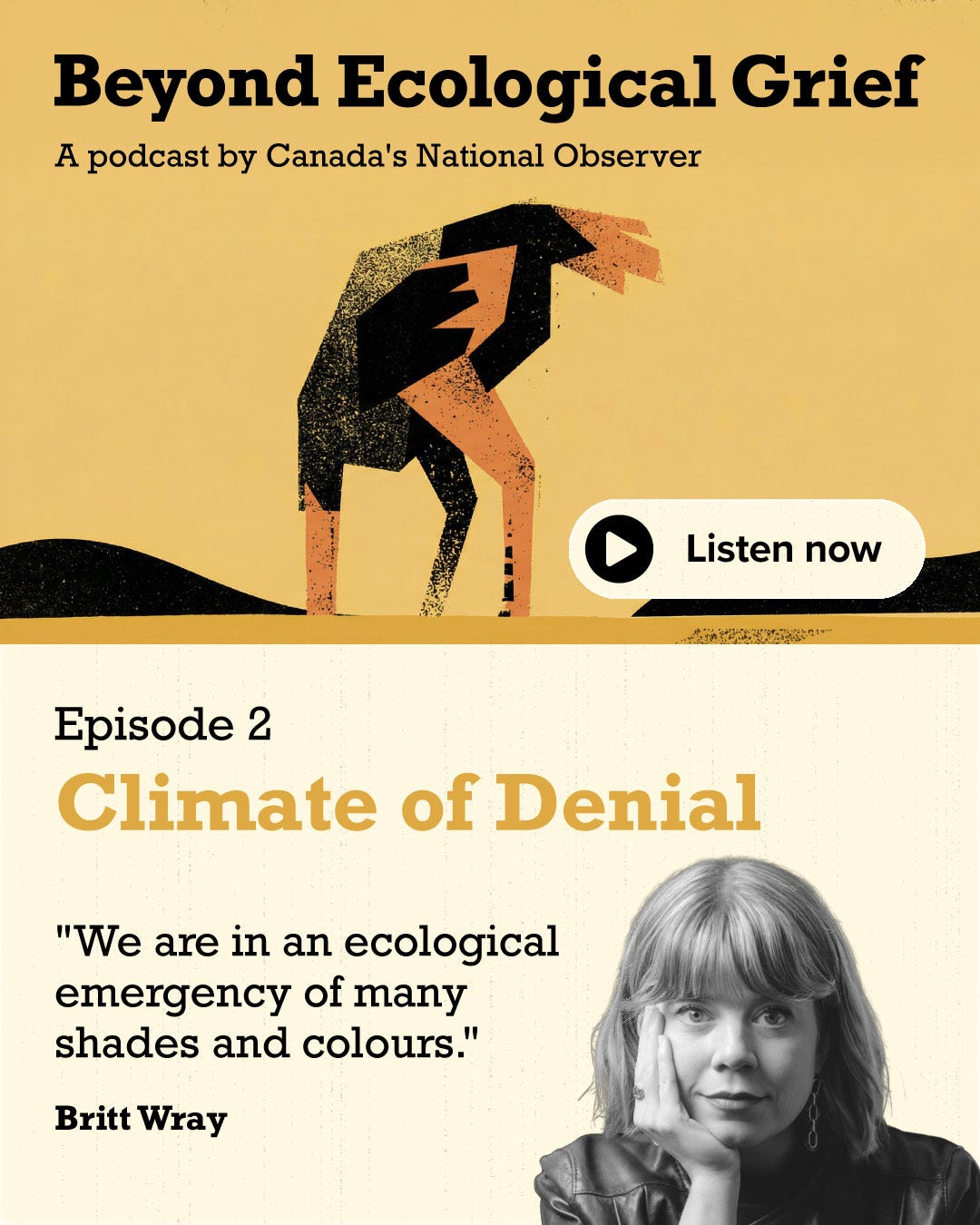
I’m really excited to share a new audio series I helped present as its resident climate psychology researcher. Beyond Ecological Grief is a new six-part podcast series by National Geographic Explorer and journalist Amy Romer in collaboration with Canada’s National Observer. It follows scientists, lawyers, land defenders, and youth to explore how the emotional responses they have to the knowledge they hold about the climate crisis can fuel the ongoing struggle for transformative climate action. The first two episodes are already out and you can find them on Spotify, Apple Podcasts, or at Canada’s National Observer.
The series traces collective grappling with the climate crisis through the famous five stages of grief as Elisabeth Kübler-Ross described them: denial, anger, bargaining, depression, and acceptance. When Romer first reached out to ask me if I’d participate as a backbone voice that links the episodes together through climate psychology commentary, I shared my perspective that the Kübler-Ross model of grief is not a perfect fit for the climate crisis, which I’ll unpack in a moment. Romer stuck with it as a format to hang the series on, which I think works well.
Denial — perhaps the most notorious of these stages — is what episode 2 focuses on, and if you want to hear me get absolutely schooled on my science communication tactics by a highly accomplished climate scientist, check out that episode. Simon Donner, a professor of climate science at the University of British Columbia, is introduced right after I’ve gone “full climate emergency” on the audience, according to the host, where I describe the threats we face in planetary, human, and economic terms. Donner, it’s implied, is directly responding to what I’ve said, and shares his anger about that type of climate communication because it incites fear in people, and behavioural psychology research shows that fear causes many to disengage, which we can’t afford. He’s right, of course, that when fear is all that a narrative provokes, it is often counterproductive.
Typically, threat-based messaging stems from a belief that more alarming information about the crisis will cause people to pay attention and then change their behaviour to reduce potential harms, but the effectiveness of this “deficit model of science communication”, as it is known, has been thoroughly debunked. Far from the unbiased and rational receivers of information that this model supposes humans to be, individuals instead typically interpret scientific information through their own values and attitudes to reinforce a worldview that they already hold. This is why conservatives and progressives can look at the same data and come away believing different things about what it implies. When new information is encountered that contradicts one’s long-held worldview, this creates cognitive dissonance (the experience of holding two opposing beliefs or thoughts in the mind at the same time), which is uncomfortable. To reconcile the discomfort, denial is activated to defend against the contradictory information, leading to dismissal of the inconvenient truth. You know how this works — it’s been explained thousands of times. And if not denial, another outcome may be to simply shut down due to overwhelming fear that prevents agency and self-efficacy from taking root.
Donner is firm that fear-based messaging is generally ineffective as an appeal to action, and that it is more paralytic than mobilizing for many. Cognitive psychology certainly backs up the idea that our brains overrespond to perceived losses over gains, so difficult information should be balanced with inspiring news that builds a sense of possibility that something can be done about the problem. As the psychologist Rick Hanson describes in his book Resilient, our brains are like Velcro for bad experiences and like Teflon for good ones. That’s why we so easily obsess about what’s frightening to us, and often imagine the worst when facing uncertainty. But as fear takes over — particularly if it lasts too long — our creativity, imaginative capacities, and compassion shut down, and we respond from an inflexible position, if we can respond at all.
In reality, the episode sets up a bit of a false dichotomy between our two approaches. I was asked to give a descriptive account of the climate emergency that focuses on its threats, grounding listeners in why the climate crisis is connected to grief and not only more comfortable emotions, like hope. Then, in a separate conversation, Donner discusses why climate narratives that emphasize loss are counterproductive for the majority of the public who are neither hard deniers nor already alarmed and engaged. I nodded along with what he was saying and find it to be a responsible top-level stance on climate communication. At the same time, there are nuances here: the research has produced mixed results, and the methods by which we try to understand this debate are varied. It’s one thing to measure how climate emotions, such as fear, are related to support for climate policy or intentions to take action; it’s another to measure how fear is related to advocacy one has done or action one actually takes; and it’s another thing still to measure how psychological distress about the climate crisis relates to advocacy and action, with the lurking variable being what role climate storytelling plays in manifesting the distress.
One recent study showed that stronger fear and lower dread scores predicted support for climate policy. The idea here is that fear is motivating in part because it is short-lived, while dread is a longer-lasting emotional response that mixes fear with feelings of inevitability, zapping motivation and a sense of what’s possible. A 2024 study from Anthony Leiserowitz’s group at Yale Climate Communications found that individuals who report experiencing at least some anxiety or depression about climate change are more likely to engage in collective climate action. As Yale News states about the study, “The results hold regardless of political ideology, and the researchers found no evidence that higher levels of distress would be debilitating or lead to less action” — poking holes in the paralysis myth. However, those who were already distressed were only a minority of the sample.
My stance is that it is important to create a culture of science communication capacious enough to stretch its arms wide and hold it all: the hope that’s instilled by learning about how solar and wind energy are now significantly cheaper than energy from fossil fuels; the inspiration we feel from the advancement of climate litigation that positions the courts to make progress where political will has fallen short; the awe we touch when we focus on how much beautiful life there is on this planet that can still be protected; alongside the many impacts — both actualized and anticipated — that scare us and break our hearts. (To the podcast’s credit, after Donner’s critique, the host added a line to say that both things can be true at the same time — the need to focus communications on the long-term progress we’re making in the green transition as Donner espouses, and the importance of honouring the severity of the threats we face, which I spelled out). As I’ve written before, an emotionally mature climate culture is one that can grapple with the full picture and keep moving forward in the service of life, despite discomfort.
After nine years of researching and writing about what the climate crisis does to inner life, publishing a book on the topic, and leading a research program where we publish studies that investigate the relationships between climate emotions, mental health, coping, and agency, a key thing I’ve learned is that communicators as a whole should not studiously try to shield people from their grief. Grief is not only a valid response; it is a direct measure of our love, and as such, is key to unlocking transformative change.
Let’s look again at the Kübler-Ross model of grief that I mentioned doesn’t fit how we grieve ecological losses. The first step of the Kübler-Ross model is denial of the shocking loss. The second is anger about the new reality. The third is bargaining, where one tries to make a deal with death itself (such as “if you just give me one more week to say goodbye to my loved ones and finish this unfinished business, I’ll go in peace”). The fourth step is depression, once we understand that bargaining won’t work. And finally, the fifth: acceptance. Acceptance brings relief and an ability to deal with whatever time is left. Many of these stages are relevant for thinking about ecological grief. For example, people often begin their journey of reckoning with the implications of climate science in a state of soft denial before connecting with a sense of depression or anger about its grave consequences. However, because the Kübler-Ross model is based on the experiences of terminally ill people — an inevitable and final process — it isn’t able to tightly map onto the climate crisis, where life goes on and the harms are unequally distributed. We need other kinds of grief guides to get us there.
A more accurate model for how we grieve in the ecological crisis would recognize the mobilizing power of grief as more central than the finality of death. The intensity of grief can transform us in profound ways. Climate-aware psychologist Rosemary Randall suggests a model for grieving climate change that outlines it as a series of tasks that can be taken on or rejected. The tasks are: accepting, intellectually and emotionally, the full reality of the losses that climate change causes; getting past our various forms of denial; grasping that we are fighting for the survival of what we love now (not in a generation or two, or more); working through the emotions that this truth brings up; and adjusting to the changing world around us by taking on new skills and aspects of our identity. This adjustment provides an opening for finding purpose in our pain, and the resourcefulness to take actions that will reduce more suffering and loss. Once we do that, we can reinvest back into the world the emotional energy we’ve spent grieving, now reconfigured as love — a necessary part of healing and acting from depth.
Leading grief ritual practitioner and psychotherapist Francis Weller recently explained on Sarah Wilson’s podcast that grief is a protest: a refusal to shut down, suppress our emotions, and become separate from what is happening in our world. The act of grieving is itself can be a visceral recommitment to life, and a passage for building purpose as one relearns the world — and one’s place in it — after losses one would never have chosen. The writer Elizabeth Rush puts forth the same idea beautifully when she says: “the only way to survive grief is to care for what remains with even more heart than before.” This is the power and importance of telling stories about the climate crisis that don’t only appeal to our emotional comfort, but that through their shadowy depths, appeal to our soul.
I’m hearing these episodes for the first time as they come out, just like the rest of you, and I might have additional reflections to share here as more episodes drop. If you listen, let me know in the comments — how are they landing for you? What questions are they surfacing?
Thanks for being here.
-Britt
This reminds me of the bigger conversation and topic about climate emotions. If you haven't, I highly recommend looking up "The Climate Scale" created by Isaias Hernandez (Queer Brown Vegan). They speak to a scale that includes: Eutierra, Soliphilia, Solastalgia, Eco Anxiety, Eco phobia, Eco guilt, Eco grieving, Tierratrauma & Eco rage.
Really excited to listen and hear from more folks about this topic. It's hard to mourn something that is technically still living. But being able to process it, makes it that much easier to move forward towards action ❤️
I’m currently in grad school studying this now, moving beyond Kubler-Ross and including a trauma lens. I appreciate you dearly. I wonder what your thoughts on psychedelics as a tool in this framework are?